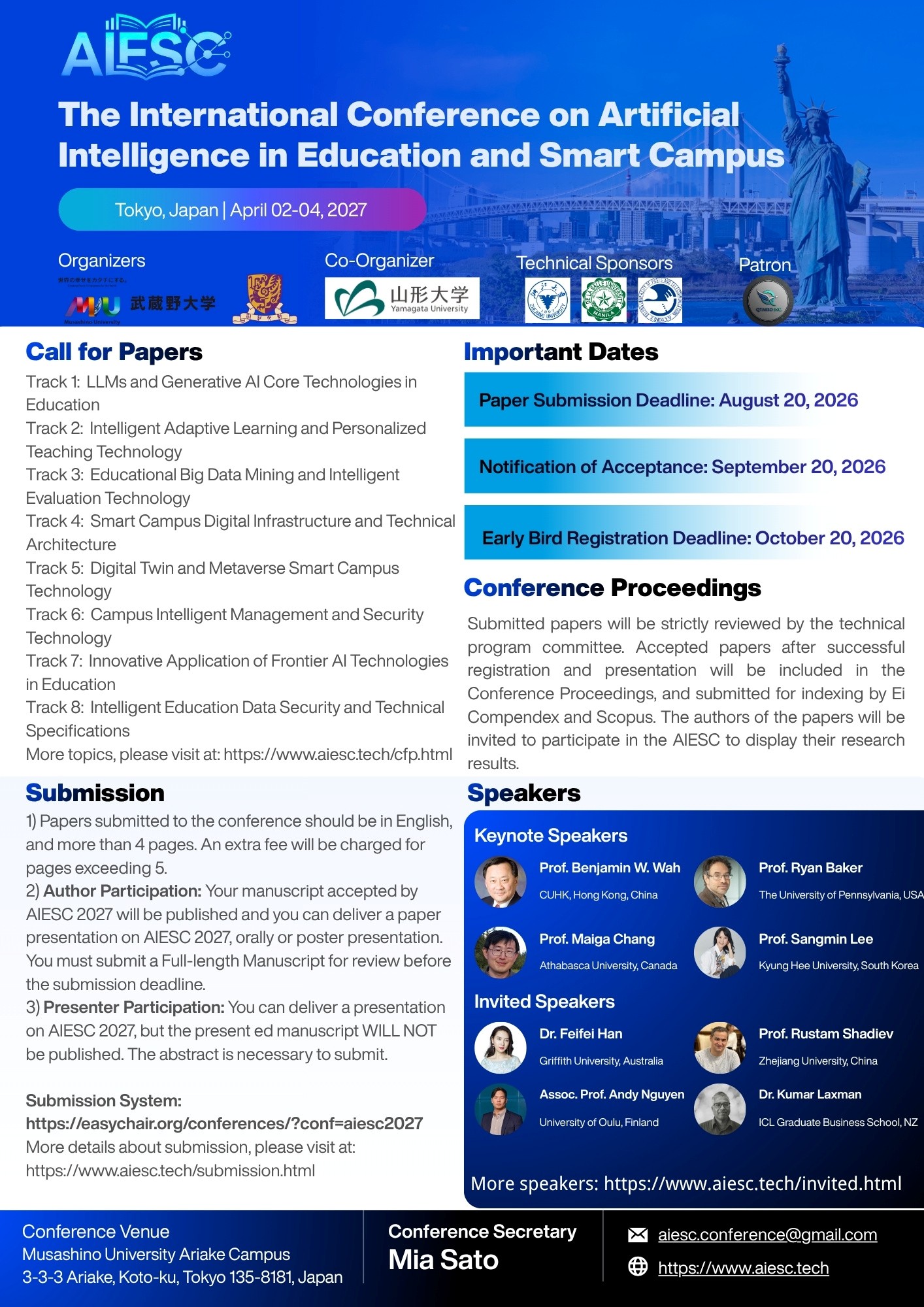
Topics of interest for submission include, but are not limited to:
Track 1: Generative AI, Foundation Models and Intelligent Learning Systems
Large Language Models (LLMs) and Foundation Models for Education
Generative AI-enabled Intelligent Learning Systems
Multimodal Foundation Models for Educational Applications
AI Agents and Autonomous Learning Assistants
Multi-Agent Systems for Education
Retrieval-Augmented Generation (RAG) for Educational Applications
Prompt Engineering and AI-assisted Knowledge Creation
Educational Natural Language Processing
Multimodal Learning and Reasoning
Knowledge-Augmented and Retrieval-Based AI Systems
Explainable, Trustworthy and Responsible Generative AI
Evaluation and Benchmarking of Generative AI Systems
Human-AI Collaborative Learning Systems
Track 2: Human-Centered AI and Human-Machine Systems in Education
Human-AI Interaction in Education
Human-Machine Interaction for Learning
Human-Centered Intelligent Educational Systems
Cognitive Computing for Education
Cognitive Modeling of Learning and Teaching
Human-AI Collaboration in Teaching and Learning
Intelligent Assistive and Companion Technologies
Affective Computing and Emotion-Aware Learning
Multimodal Human Behavior Understanding
User Modeling and Learner Modeling
Human-Machine System Modeling and Evaluation
Explainable and Interactive AI
Trustworthy Human-AI Collaboration
AI-assisted Teaching and Learning
Intelligent Learning Experience Design
Track 3: Intelligent Adaptive Learning, Cognitive Systems and Personalized Education
Intelligent Adaptive Learning Systems
Learner Modeling and Cognitive Modeling for Adaptive Education
Multi-dimensional Student Learning Profile Modeling
Personalized Learning Path Planning
Intelligent Recommendation for Learning Resources
Adaptive Difficulty Modeling and Optimization
Intelligent Question Generation and Adaptive Assessment
Intelligent Identification of Learning Weaknesses
Personalized Feedback Generation
Adaptive Learning in Online and Blended Education
AI-based Differentiated and Individualized Instruction
Cognitive AI for Personalized Learning
Reinforcement Learning for Adaptive Education
Continual Learning for Personalized Educational Systems
Intelligent Tutoring Systems
Track 4: Educational Data Intelligence, Machine Learning and Intelligent Decision-Making
Chair: Assoc. Prof. Ying Tang, Southwest University, China
Machine Learning for Educational Data Analytics
Deep Learning for Learning Analytics
Educational Data Mining
Multi-source Learning Behavior Modeling
Student Behavior Modeling and Prediction
Learning Pattern Recognition
Intelligent Identification and Prediction of Academic Risks
Early Warning Systems for Learning and Academic Performance
Intelligent Decision Support for Education
Explainable Machine Learning for Educational Applications
Causal Learning and Causal Inference in Education
Federated Learning for Educational Data
Privacy-Preserving Machine Learning
Intelligent Assessment and Evaluation
Dynamic Modeling of Learning Processes
Data-Driven Optimization of Teaching and Learning Systems
Track 5: Smart Campus Systems, IoT and Intelligent Infrastructure
Intelligent Smart Campus Systems
Internet of Things (IoT) for Smart Education
Intelligent Sensing and Context-Aware Computing
Cloud-Edge-Device Collaborative Intelligence
Edge AI for Smart Campus Applications
Intelligent Campus Data Infrastructure
Cyber-Physical Systems for Smart Campus
Intelligent Resource Allocation and Scheduling
Intelligent Computing Resource Management
Autonomous Campus Service Systems
Intelligent Campus Network Management
AI-enabled Infrastructure Monitoring
Intelligent Building and Energy Management
Context-Aware Smart Learning Environments
IoT-enabled Learning Environments
Intelligent Campus Operations and Services
Track 6: Digital Twins, Embodied AI and Cyber-Physical Learning Environments
Digital Twin for Smart Campus Systems
Digital Twin Modeling and Simulation
Real-Time Digital Twin Synchronization
Cyber-Physical Learning Systems
Embodied AI for Education
Intelligent Robots for Education
Human-Robot Interaction in Learning Environments
Autonomous Learning Agents and Robotic Assistants
Virtual and Augmented Reality for Intelligent Learning
Immersive Learning Environments
Multimodal Perception for Smart Learning
Intelligent Virtual Laboratories
Digital Twin-based Campus Management
Simulation and Optimization of Smart Campus Systems
Multi-Agent Collaboration in Virtual Learning Environments
Track 7: Campus Intelligent Management and Security Technology
AI-based Intelligent Recognition and Monitoring of Campus Personnel and Vehicles
Intelligent Early Warning and Detection of Abnormal Campus Behaviors
Intelligent Inspection, Operation and Maintenance of Campus Facilities
Intelligent Optimization of Educational Scheduling and Classroom Resource Allocation
Fine-grained Analysis of Student Campus Behaviors
Intelligent Campus Office Automation
Big Data Analytics and Risk Prediction for Campus Security Management
Track 8: Trustworthy AI, Cybernetics, Security and Emerging Intelligent Technologies
Trustworthy and Responsible AI
Explainable AI
Fairness and Bias Mitigation
AI Safety and Robustness
Adversarial Machine Learning
Security of AI-enabled Educational Systems
Secure and Trustworthy Smart Campus Systems
AI Model Vulnerability Detection
Cybersecurity for Intelligent Learning Systems
AI-based Anomaly Detection
Risk-Aware Intelligent Systems
Emerging Cybernetic Systems